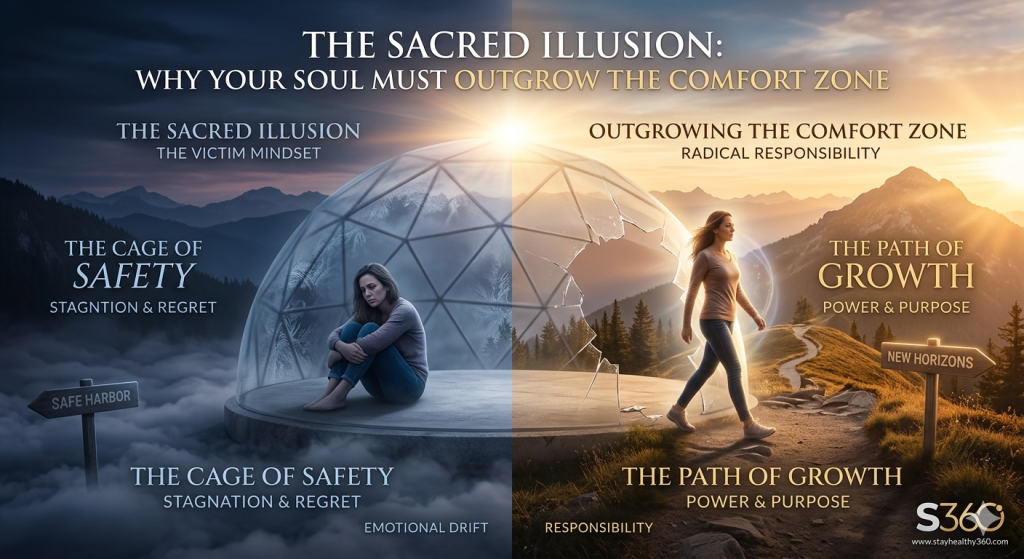
The Gilded Cradle: A Sanctuary or a Shroud?
Within each of us lives a child seeking warmth and a visionary seeking the stars. The comfort zone is that warm, familiar cradle. It feels like a mother’s embrace—protective, soft, and predictable. But there is a sacred truth we must face: A cradle is a beautiful place to start, but a tragic place to stay.
When we linger too long in the “safe,” the walls that once protected us begin to diminish us. To love yourself deeply is to recognize when your soul has grown too large for its current container.
1. The Quiet Heartache of “Safety”
We often mistake the absence of struggle for the presence of peace. But “No-Pain” is an illusion that carries its own heavy price.
- The Weight of Unlived Days: There is a specific kind of sorrow that comes from looking in the mirror and seeing a version of yourself that hasn’t changed in years.
- The Whisper of the Soul: That restless feeling you have at night? It isn’t anxiety; it is your potential knocking on the door of your heart, asking to be let out into the wild.
Choosing the “safe” path doesn’t protect you from pain; it only trades the vibrant ache of expansion for the hollow ache of regret.
2. The Victim Trap: The Mirror of Powerlessness
The most dangerous corner of the comfort zone is the Victim Mindset. It feels like a refuge because it exempts us from blame, but it is actually a “safe” cell in a prison of pain. When we believe our stagnation is the fault of our past, our environment, or others, we unknowingly hand over the keys to our happiness.
In this state, you remain in a cycle of perpetual ache. Why? Because if you are not the cause of your problem, you cannot be the source of your solution. To stay a victim is to choose a lifetime of waiting for a rescue that only you can provide.
3. Fear: The Gatekeeper of Your Radiance
Fear is not your enemy. In the vision of love, fear is simply a misunderstood guardian. It stands at the edge of your comfort zone, trying to protect the person you were, unaware of the magnificent person you are becoming.
When your heart beats fast at the thought of a new challenge, don’t call it “terror.” Call it Alignment. Your body is simply preparing the energy required for your next breakthrough. Fear is the bridge you must cross to meet your truest self.
4. Radical Responsibility: Your Ultimate Liberation
The moment you say, “I am responsible for my life,” the walls of the comfort zone crumble. Responsibility is not a burden; it is your sacred liberation.
- From Pain to Power: Taking responsibility means you no longer wait for the world to change so you can feel better. You become the alchemist of your own emotions.
- Dissolving Fear: Fear thrives on the “unknown others.” When you own your choices, fear loses its grip because you realize that even if you fall, you are the one with the power to rise.
- The Alchemy of Discomfort: Responsibility is the bridge between the pain of the past and the light of the future. It is the brave act of reclaiming your energy.
5. Walking Toward Your Light: A Practice of Love
To leave your comfort zone is to walk toward the light of your own vision. Start with these gentle, loving steps:
- Honor the Fear: Say to your fear: “I see you trying to protect me. Thank you. But we are going this way now.”
- The “Micro-Discomfort” Habit: Do one small thing daily that makes you slightly nervous. Small steps build the bridge to giant leaps.
- Follow the “Joy-Spark”: What idea makes you feel “alive” and “nervous” at the same time? That is your North Star.
Conclusion: The Choice of Your Heart
The comfort zone is not a sanctuary; it is a mirror reflecting the greatness you are still afraid to claim. Whether you stay or leave, life will move. The question is: Will you move with it?
The version of you that is free, purposeful, and radiant is waiting just beyond the fog of the “predictable.” Step out. Not because you are not enough where you are, but because you are too much to stay there. Stop being a spectator in your own life. Embrace the responsibility. Embrace the growth. Embrace your Glow.